
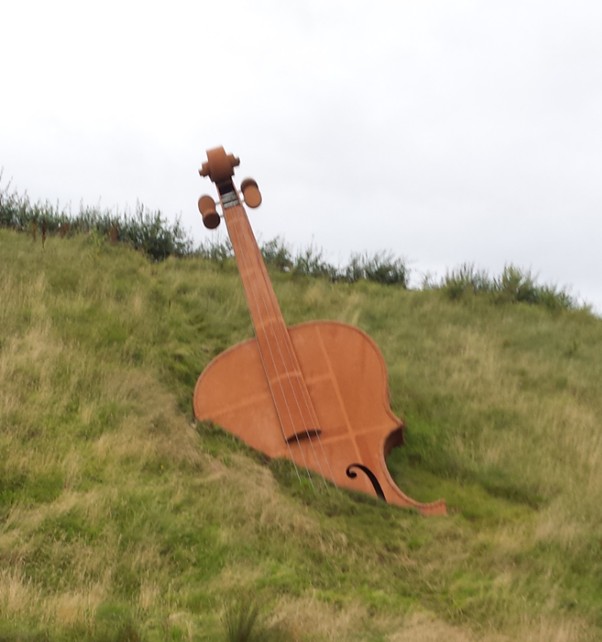
“Music has no boundaries” is an oft-quoted expression reflecting the ability of music to transcend geographical and cultural borders. While music itself can travel freely between countries and communities, this was not necessarily true of the musicians who transmitted it. Before the advent of modern travel and mass migration in the late 19th and early 20th centuries, musicians and their music-making were, for the most part, rooted in their local communities and surrounding areas.
While researching the musical career of the Longford fiddle master Thomas ‘Blind’ Kiernan (c.1807–87), Conor Ward found that Kiernan’s musical activities, together with those of the generations of fiddle players influenced by his teaching, were concentrated within a distinct geographical area. This area encompasses south County Leitrim, County Longford, and adjoining parts of counties Cavan, Roscommon and Westmeath.
This musical region corresponds closely with the ancient tribal territory of Conmhaicne Maigh Réin. Today, the area is more commonly referred to simply as “Conmhaicne”. Its history can be traced to the Conmhaicne people of early medieval Ireland, whose name is traditionally derived from the mythical ancestor Conmac, meaning “hound-son”. According to tradition, Conmac was the third son of Fergus mac Róich and Queen Medb of Connacht.
For many generations, the Conmhaicne are said to have lived in the vicinity of Dunmore, County Galway. Around the 6th century, they began to expand into territories occupied by other tribal groups. At this time, their chief was Cumascrach, and these migrations were led by the descendants of his sons. The descendants of Cumascrach’s second son, Findfer, migrated eastwards into south Leitrim, settling in Maigh Réin, the area around present-day Fenagh. Here they established the territory that became known as Conmhaicne Maigh Réin.
Over subsequent centuries, south Leitrim was occupied and governed by several prominent Gaelic septs and families, whose territories encompassed much of the three modern-day baronies of Leitrim, Mohill and Carrigallen.
- Muintir Eolais: Ruled by the MacRaghnaill (Reynolds) clan, Muintir Eolais occupied much of south Leitrim and extended into parts of north County Longford. Their territory included two extensive areas known as Maigh Nissi, the plain along the River Shannon, and Maigh Réin, the plain around Fenagh. Collectively, this territory covered much of the modern baronies of Mohill and Leitrim, together with parts of the Carrigallen barony.
- Cinel Luacháin: Ruled by the MacDarcy clan, this territory was centred on the areas around Oughteragh, Ballinamore and Drumreilly in the modern barony of Carrigallen.
- Muintir Cearbhalláin: Ruled by the O’Mulvey clan, this territory was centred on Carrick-on-Shannon and Drumshanbo within the modern barony of Leitrim.
Another branch of the Conmhaicne, the Muintir Angaile, settled in County Longford, where they were ruled by the Ó Fearghail (O’Farrell) clan. Thus, the historical territory associated with the various branches of the Conmhaicne extended well beyond present-day county boundaries.
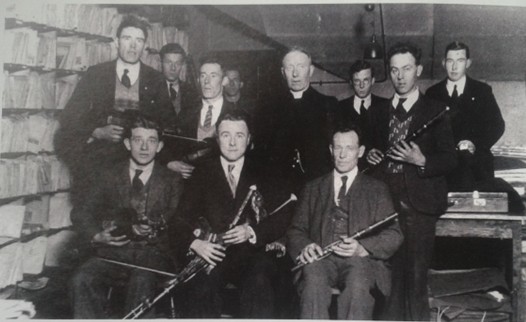
Back L-R: William Doherty`(1907-88 – Streamstown); James ‘Sonny’ Pope (c1911-? – Cloone Village); ‘Little’ Jimmy McKiernan (1902-88 – Tooma); James ‘Black’ Pope (c1911-? – Cloone Village), Fr Peter Conefry (1880-1939, P.P. Cloone Parish); unknown – friend of Fr McGarry; Jack Rourke (Tooma & Cloone Village); Fr McGarry (Cloone Village).
Front L-R: Michael M. Creegan (1909-? – Cloone village); Leo Rowsome (1903-70 – Ferns, Co Wexford); Sonny Canning (Drumshanbo North)
The ecclesiastical history of the region also reflects its association with the Conmhaicne. The Diocese of the Conmaicne, or Ardagh, was established in 1111 as a diocese for the eastern part of Connacht. Following the Synod of Kells in 1152, its geographical boundaries were adjusted to encompass the territories of the Conmhaicne in County Longford and south County Leitrim. The exception was the territory of the Cinel Luacháin, which was incorporated into the Diocese of Kilmore, associated with the wider Breifne region of counties Cavan and Leitrim.
The name and identity of the Conmhaicne have continued to resonate in the region into modern times. The present-day Catholic parish of Cloone, for example, was known for centuries as “Cluain Conmhaicne”, translated from Irish as “Conmaicne of the pasture”.
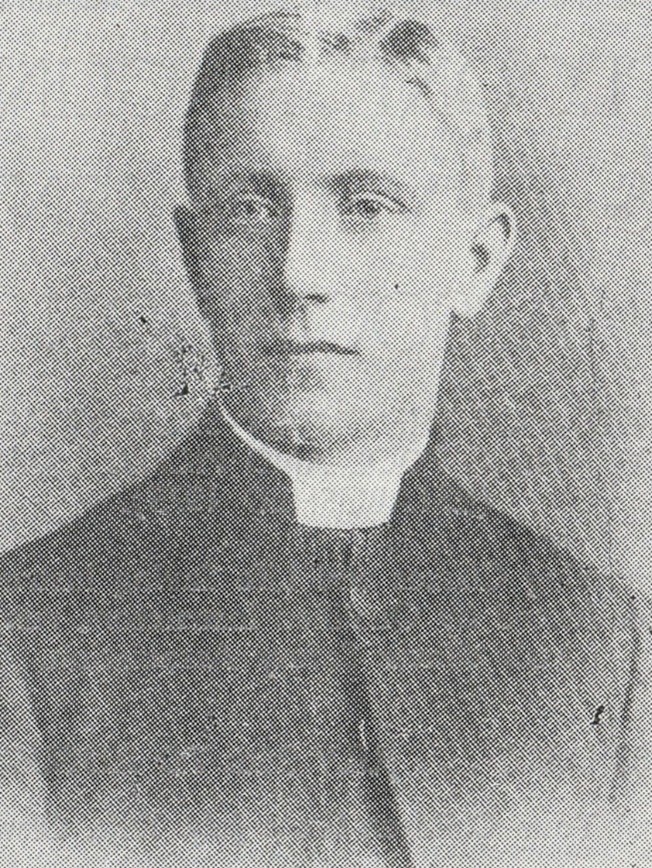
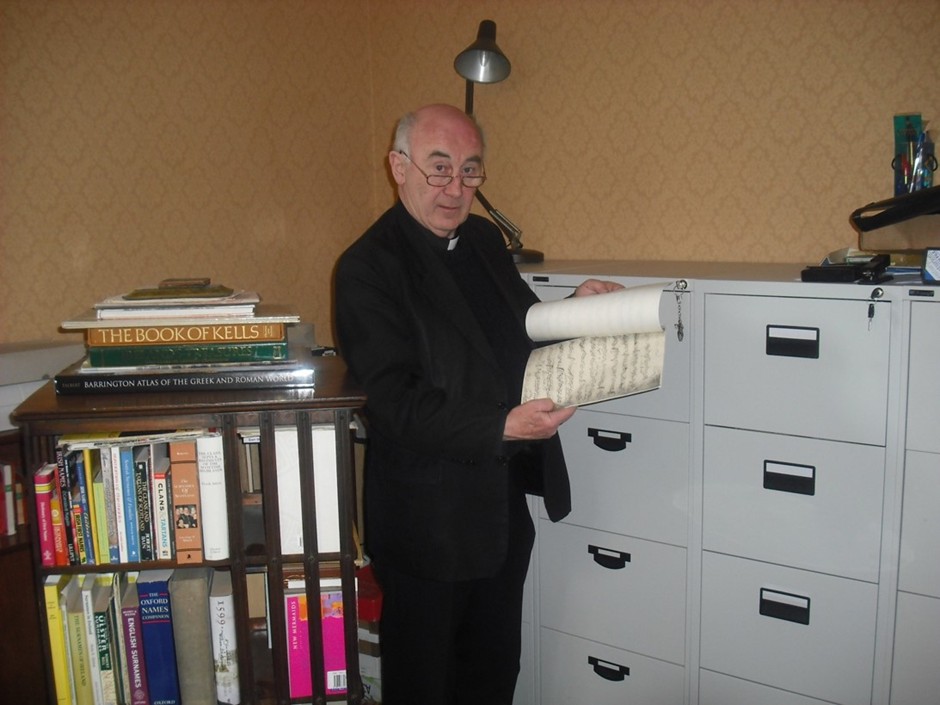
The name also found an expression in the region’s musical life. In the 1930s, Fr Peter Conefrey (1880–1939), the famous anti-jazz activist, was parish priest of Cloone. He trained a céilí band of local musicians which became known as the “Conmhaicne Céilí Band”. More than half a century later, in the 1990s, Fr John Quinn (b. 1940), current parish priest of Gortletteragh, similarly formed a céilí band under the name “Ceoltóirí Conmhaicne”, consisting of musicians from mostly south Leitrim and county Longford.
The connection between the historical identity of the Conmhaicne and the region’s musical heritage was further recognised in 2016, when Conor Ward and Fr John Quinn established the music society Cumann Ceoil Chonmhaicne. The society’s core aims are to preserve and promote the traditional Irish music, song and dance that have developed within this distinctive region.
The persistence of the name “Conmhaicne” in the musical life of south Leitrim and Longford is particularly significant when viewed alongside the musical lineage of Thomas ‘Blind’ Kiernan. His influence extended across much the same geographical area, suggesting that the boundaries of this historic territory may also provide a useful framework for understanding the development and transmission of its distinctive traditional music.
Conor Ward, September 2026