
Philip 'Red Phil' Brady(aka ‘Red’ Phil or ‘Phil of the Hill’)
(1864-1946) [confirmed with records]
Fiddle
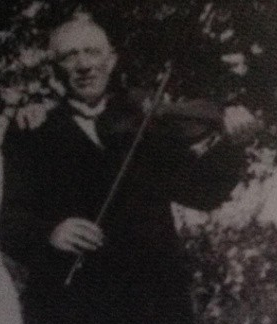
Parish: Drumlish
Townland: Gaigue
Place of birth: Gaigue, Drumlish Parish, Co Longford
Listing in the census:
- 1901 Census of Ireland - House 48, Graigue (sic), Killoe, County Longford
- 1911 Census of Ireland - House 30, Gaigue, Killow (sic), County Longford
- 1926 Census of Ireland - Gaigue, Killoe, County Longford (no household number, Philip is aged 62)
Philip Brady, more commonly known as ‘Red’ Phil, was taught the fiddle by Thomas Kiernan (c1807-87). The fiddle player Michael Francis McNerney (1898-1975) recalled in a 1973 interview that when Kiernan was teaching ‘Red’ Phil he received as payment “the run of his tooth” which consisted of “a noggin of whiskey for breakfast and plentiful supply of his favourite brand of tobacco”.
According to McNerney, the aforementioned fiddle player, ‘Red’ Phil, was very proud of the fact that he was taught by Kiernan. He recalled a humorous incident that occurred in Ballinamuck in the year 1914, when travelling musicians, the Smyth brothers, insulted ‘Red’ Phil by comparing him to another local fiddle player, John Burns, whose playing was not well regarded in musical circles:
Phil Brady of Gaigue, he was an oldish man, you know. And he was down in Ballinamuck this night and he played a certain amount of tunes. Smyth wasn’t impressed at all, he said: ‘ah sure, you can play none, no more than John Burns down the road’. He [Brady] says: ‘Up! Bad luck to him, and me learned by ould Kiernan’
Despite Smyth’s attempted insult, it appears from the following anecdote, retold by Annie Hurson, that Brady was not short of confidence: “Someone said to Phil: ‘you could play for the Bishop’, to which he replied: ‘I could play for a barn full of Bishops!’”
According to John Farrell, who collected folklore from his local region of Gaigue in 1937 as part of The [National] Schools’ Collection 1937-1939, ‘Red’ Phil was also a renowned seanachaí in the area: “A great storyteller is Phil Brady, Gaigue Upper. He can tell hundreds of stories about the fairies and good people”. One of these stories that Farrell collected from ‘Red’ Phil, ‘Fairy Castle in Cornawn Bawn’, has a musical theme, highlighting the importance of folk music in local lore during that period:
Once there lived in Gaigue Hill a man named Mick Herson. He was a grandfather or great-grandfather of the present John Herson. His field bordered upon Cornawn Bawn. In the summer he used to get up at daybreak and drive out his cows to feed before the heat of the morning came. Each morning he was brought into in a great castle in Cornawn Bawn and got his breakfast. He saw a great amount of people there and among them was James Herson the flute player who had died some time before. The fairies minded the cows for him while he was in the castle eating his breakfast.
Circumstantial evidence indicates that ‘Red’ Phil taught a number of fiddle players in his native Gaigue and in the surrounding region including Margaret Reynolds, members of the Cole family, Johnny Hurson, Michael Brady and Anna White.
Mary Hughes neé Brady, recalled that when her mother, Margaret Reynolds, was teaching her the fiddle as a young girl, she often quoted the mantra, “finger tight and bow light”, which Margaret stated she had learned herself from her own teacher, who is likely to be ‘Red’ Phil.
Teacher: Thomas ‘Blind’ Kiernan (c1807-1887), Cartrongolan, Drumlish Parish, County Longford
Student(s):
Verified Students:
- Cole family siblings, Anne Cole (1892-?), Gaigue, Drumlish Parish, County Longford
- Bridget Cole (1899-?), Gaigue, Drumlish Parish, County Longford
- Kathleen Cole (1904-?), Gaigue, Drumlish Parish, County Longford
- Niece, Anna White neé Brady (1911-?), Fardromin, Drumlish Parish, County Longford
Unverified Students:
- Margaret Brady neé Reynolds (1908-1995), Gaigue, Drumlish Parish, County Longford and later Aughafin, Mostrim Parish, County Longford
- Michael Joseph Brady (1895-1973), Kilmahon, Drumlish Parish, County Longford and later Kilshrewly, Clonbroney Parish, County Longford
- Johnny Hurson (1922-1999), Gaigue, Drumlish Parish, County Longford
Related musicians:
- Undetermined cousin, Michael Joseph Brady (1895-1973), Kilmahon, Drumlish Parish, County Longford and later Kilshrewly, Clonbroney Parish, County Longford
- First cousin, Patrick Brady (1861-1952), Gaigue, Drumlish Parish, County Longford and later Newtownforbes Village, Clonguish Parish, County Longford
- First cousin, Peter Brady (1859-1939), Gaigue, Drumlish Parish, County Longford and later Aughafin, Mostrim Parish, County Longford
- Niece, Anna White née Brady (1911-?), Fardromin, Drumlish Parish, County Longford
Occupation(s): Farmer
Family:
Spouse: Eliza Reilly (c1870-fl.1926), Gelsha, Colmcille Parish, married in 1905
Children: (1) no name provided (1907-1907). 1911 census states they had two children, neither survived.
Parents: John Brady (c1830-1905) and Mary Brady (c1840-1903)
Siblings: Alicia (1859-?), Catherine (1861-?), Ellen (1866-?), Patrick (1868-?), John (1875-fl.1926), Anne (c1877-fl.1901), Brigid (c1878-fl.1901)
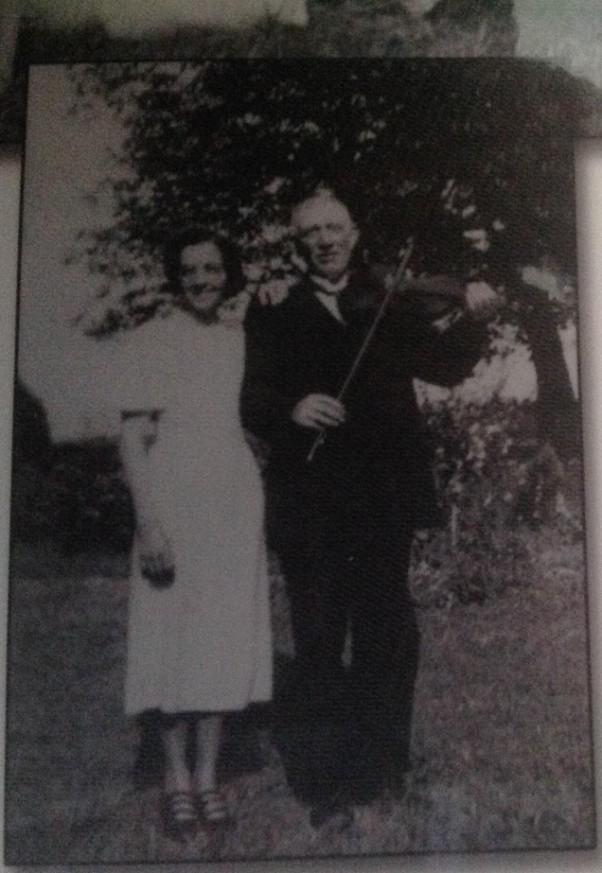
Manuscripts:
Some of the repertoire in the O’Farrell–Reynolds manuscript collection, dating from c. 1870s–1930s, appears to have been transcribed by Philip Brady (1864–1946). This attribution is based on several strands of evidence, including a comparison between Brady’s signature in the 1911 Census of Ireland and the handwriting of the tune titles in the manuscripts.
Brady lived in Gaigue, beside Margaret, and was a fiddle teacher who was still teaching around 1930. He had also learned fiddle from Thomas ‘Blind’ Kiernan (c. 1807–1887), providing a possible link between the manuscripts and Kiernan’s teaching tradition.
Further evidence of this connection can be found in the music itself. Brady’s repertoire includes a prelude exercise, reels marked with the bowing technique known as “slur and cut”, and a small number of tunes that can be compared with repertoire preserved in other manuscripts and recordings of fiddle players associated with Kiernan’s teaching.
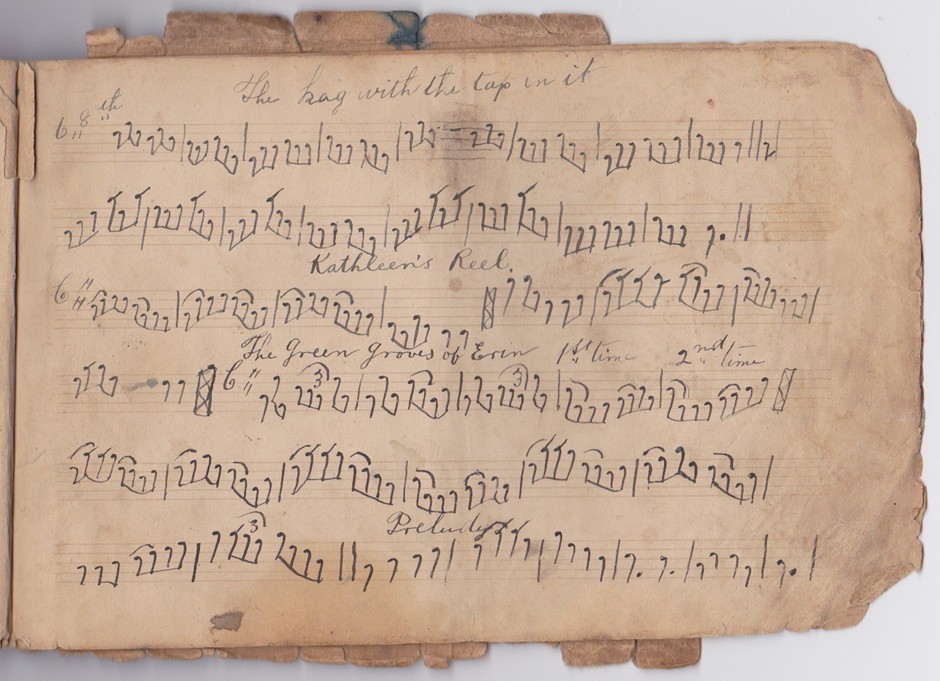
The neighbouring Cole family, who were of a similar age to Margaret, were also taught fiddle by Brady. The signatures of Brigid and Annie Cole, along with that of their uncle James, appear in one of the manuscripts transcribed by Brady. It is possible that Margaret and members of the Cole family attended lessons together, which would help explain their presence in this manuscript.
Although elements of Brady’s repertoire reflect the musical tradition associated with Kiernan, most of the tunes have no known connection to his teaching or to other surviving written and recorded sources of local music. This suggests that Brady continued to expand his repertoire throughout his musical career, acquiring tunes beyond those inherited through his early training. Taken together, the manuscripts offer a glimpse of how an older local fiddle tradition was preserved, particularly in terms of teaching techniques, while musicians continued to learn and circulate new music.